Expansion Revenue Strategies: Upsell, Cross-sell, and Price Increases
Master the three expansion revenue strategies that drive 120%+ NRR: upsells, cross-sells, and strategic price increases for sustainable SaaS growth.
When people talk about SaaS growth, they focus on new customer acquisition. Close more deals. Build better sales processes. Outbound outreach. Landing pages.
But here's what the 120%+ NRR clubs know: acquisition is expensive and unpredictable. Expansion revenue is cheap, predictable, and compounds.
Consider the math: You close a $10,000 ARR customer. Your CAC was $5,000. Without expansion, you're break-even at month 6. But with just 30% expansion revenue annually, that customer generates $13,000 in year two. Suddenly, you're growing 30% from your existing base—without spending a dollar on acquisition.
This is why SaaS companies with >120% NRR can grow faster than those with 95% NRR despite lower acquisition spend. They've built expansion revenue into their business model.
The question isn't whether you should pursue expansion revenue. The question is: which strategies will work for your product and customer base?
What is Expansion Revenue?
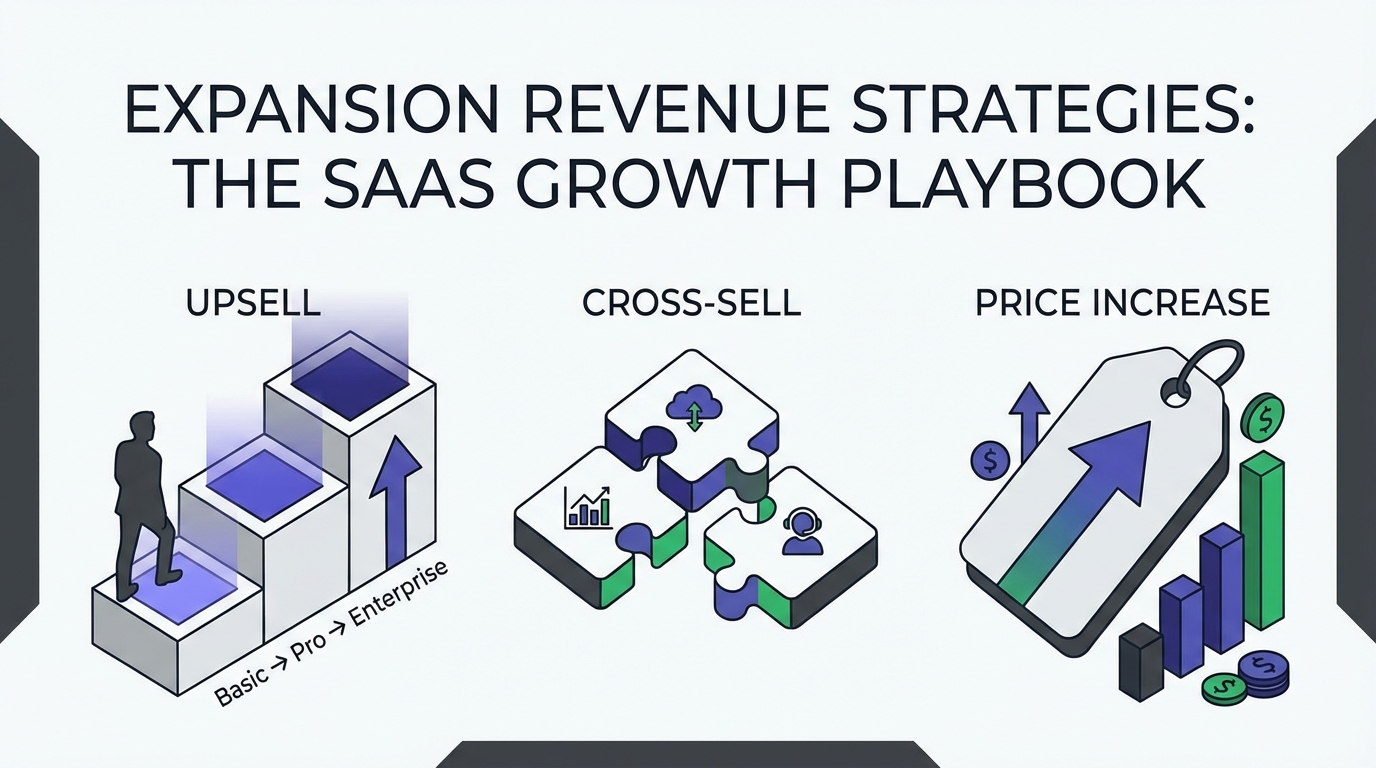
Expansion revenue is any money your existing customers pay beyond their original contract value. It comes in three flavors:
Upsell
Moving a customer to a higher-tier plan or adding paid features to their current setup
- Example: Customer on "Starter" plan upgrades to "Professional"
- Example: Adding 10 additional seats to an existing account
Cross-sell
Selling adjacent products or modules to existing customers
- Example: Customer using analytics adds your CRM tool
- Example: Customer using your API adds your webhooks/automation module
Price increases
Raising prices on renewals while maintaining the same product
- Example: Annual price increase (usually 3-10%)
- Example: Value-based repricing on renewal
All three contribute to your expansion MRR (expansion monthly recurring revenue) and ultimately drive your net revenue retention (NRR) above 100%.
The Economics of Expansion Revenue
Let's quantify why expansion matters.
Scenario Comparison
| Metric | Acquisition Only | Acquisition + 25% Expansion |
|---|---|---|
| Starting MRR | $100k | $100k |
| CAC Payback | 12 months | 12 months |
| Customer Lifespan | 36 months | 36 months |
| LTV/CAC Ratio | 3:1 | Higher due to expansion |
| Year 2 Revenue | $130k (+30% new sales) | $155k (+30% new + 25% expansion) |
| Year 3 Revenue | $169k | $240k (compounding expansion) |
The expansion scenario generates $71k more revenue in year 3 with the same sales spend.
The CAC Multiplier
New customer acquisition isn't just more expensive—it's exponentially more expensive than expansion.
| Revenue Source | CAC | Economics |
|---|---|---|
| New Customer | $5,000 | Full sales cycle, demo, negotiation |
| Expansion | $500 | Email, brief call, internal approval |
To generate $5k in expansion revenue, you need one customer to increase their spend by $5k. But that customer already knows your product. They've seen value. There's no negotiation. That $500 CAC assumes 10:1 better economics than new sales.
If you can expand 5 customers by $1,000 each (very achievable), you've generated $5k revenue with $2,500 in CAC instead of $5,000.
Upsell Strategies That Actually Work
Upselling is the fastest path to expansion revenue because it doesn't require building new products—just unlocking value customers aren't using yet.
Tier-Based Upsells
The most straightforward upsell is the plan upgrade.
Structure:
- Starter Plan: Core features, 1 user, $99/month
- Professional Plan: All features, 5 users, $299/month
- Enterprise: Unlimited users, custom features, $999/month
Upsell Trigger: Customer has 3+ active users (approaching Starter limit)
Conversation: "We noticed your team is growing—I want to make sure you're on the right plan. The Professional plan includes dedicated support, API access, and unlimited integrations. Would that be valuable as your team expands?"
Expected Conversion: 20-40% of customers in expansion stage
Seat-Based Expansion
For products where value scales with team size, seat expansion is a reliable revenue driver.
How it works:
- Pricing is per-seat: $30/user/month
- Customer starts with 5 seats
- As they add team members, seats are automatically added (either usage-based or manual add)
- Year 1: 5 users → $1,800 ARR
- Year 2: 8 users → $2,880 ARR (60% expansion)
Why it works: Expansion is automatic—tied to their business growth, not a sales conversation.
Typical seat expansion: 20-50% annual growth in power accounts
Usage-Based Expansion
For metrics-driven products (analytics, API usage, data processing), usage-based pricing creates natural expansion:
Structure:
- Base fee: $500/month for software access
- Usage tier: $0.10 per API call
- Customer month 1: 100k API calls = $1,500 (base + usage)
- Customer month 3: 300k API calls = $3,500 (natural expansion)
Why it works: Customer expands as they grow—no sales conversation needed.
Key advantage: Customers know pricing is tied to their usage, so expansion feels natural and fair.
Feature Add-Ons
Beyond tier upgrades, you can sell advanced features as add-ons:
| Feature Add-On | Price | Typical Use Case |
|---|---|---|
| Advanced security/SSO | $200/month | Enterprise compliance requirements |
| Dedicated account manager | $300/month | High-touch customers needing support |
| Priority support | $100/month | Mission-critical implementations |
| Advanced reporting | $150/month | Analytics-driven teams |
Trigger: Customer uses base product heavily, asks for a feature not in their tier
Conversion rates: 15-30% depending on feature perceived value
Cross-Sell Strategies for Product Expansion
Cross-selling works best when you have genuinely complementary products that solve adjacent problems.
Platform Play (Land → Expand → Platform)
The most common cross-sell model:
- Land: Customer buys Module A (e.g., analytics)
- Expand: Customer becomes power user of Module A
- Platform: Introduce Module B (e.g., CRM) that integrates with Module A
Example: Slack started as a communication tool, then upsold workflow automation, then APIs.
Key success factor: Module B should be 10x better for someone already using Module A than for a new customer.
Bundled Offerings
Group your products into packages that customers perceive as better value:
| Offering | Individual Pricing | Bundle Pricing | Savings |
|---|---|---|---|
| Analytics | $299/month | ||
| CRM | $399/month | ||
| Automation | $199/month | ||
| Total | $897/month | $699/month | 22% |
Cross-sell effect: Customers save 22%, you increase their switching cost, they expand wallet share by moving from 1 product to 3.
Vertical-Specific Add-Ons
If your product serves multiple verticals, you can cross-sell vertical-specific modules:
Customer using basic payroll software → Upsell "Payroll for Construction" (includes prevailing wage rules, union requirements)
Customer using basic accounting → Upsell "Accounting for SaaS" (ARR tracking, deferred revenue, cohort analysis)
The base product gets them in the door. Vertical specialization keeps them.
Partner Integrations as Revenue
Build marketplace integrations with complementary tools, then cross-sell:
Customer using your project management tool → Suggest time tracking integration → Partner pays commission or revenue share.
This is effectively free cross-sell revenue since the integration partner does the selling.
Price Increases: The Simplest Expansion Tactic
Many SaaS companies under-utilize price increases. They generate expansion revenue with minimal friction—if done right.
Annual Price Increase Strategy
Most SaaS companies raise prices 5-10% annually on renewals:
Year 1: 100 customers at $1,000 = $100,000 ARR Year 2: Same 100 customers at $1,050 (5% increase) = $105,000 ARR (expansion!)
Key principle: Raise prices on renewal, not mid-contract.
This gives customers a decision point. Most renew at the new price because:
- They've gotten value in year 1
- Switching costs are high
- The increase feels modest
Typical renewal price increase: 4-8% with 90%+ retention at new prices
Value-Based Repricing
Rather than percentage increases, tier your pricing based on customer value:
| User Segment | Old Pricing | New Value-Based Pricing |
|---|---|---|
| Small users (< 1000 usage points) | $1,000/month | $500/month |
| Medium users (1000-10000) | $1,000/month | $1,500/month |
| Power users (> 10000) | $1,000/month | $3,000/month |
Effect: You're extracting more value from customers getting more value. Churn stays low because they're paying according to what they get.
Grandfathering Considerations
When you raise prices, should you grandfather existing customers?
| Approach | Description | Pros | Cons |
|---|---|---|---|
| Strong grandfathering | Old customers stay at old price forever | Rewards loyalty | Creates pricing tiers, margin divergence |
| Weak grandfathering | Old price for 1-2 years, then raise | Gives time to find value | Delays revenue impact |
| No grandfathering | New price on every renewal | Simplest, fastest revenue impact | Higher churn risk (usually lower than expected) |
Most successful companies use weak grandfathering: honor the old price on this renewal, raise on the next one.
Designing Your Product for Expansion
Some products are expansion-proof. If growth doesn't naturally lead to expansion, no sales technique will fix it.
Pricing Mechanics That Drive Expansion
| Pricing Model | How It Drives Expansion | Best For |
|---|---|---|
| Usage limits | Features limited by usage (API calls, storage, users) | APIs, data platforms, communication tools |
| Feature tiers | Higher tiers unlock features | Software platforms, SaaS tools |
| Seat-based | Price scales with team members | Collaboration tools, HR tech, sales tools |
| Module-based | Separate products you can bundle | Suites of related tools |
Product-Led Expansion Triggers
Build expansion signals into your product experience:
Trigger: Customer reaches 90% of monthly API limit Action: Show in-app message → Offer upgrade to higher tier Result: Some convert without talking to sales
Trigger: Customer hasn't used 3 advanced features Action: Onboarding tour → Feature education Result: Customer discovers value, more likely to buy feature add-on
Trigger: Team size grows to 20% above seat plan Action: Suggest upgrade → Easy self-serve checkout Result: Customer upgrades in minutes, no sales call needed
Operationalizing Expansion Revenue
Expansion won't happen by accident. You need systems and incentives.
Expansion Playbooks by Account Segment
Different accounts expand for different reasons:
| Segment | Primary Expansion Driver | Playbook |
|---|---|---|
| High-growth startups | Seat growth (natural as they hire) | Self-serve seat expansion + occasional check-in |
| Mid-market | Feature upgrades + price increases | Annual QBR + usage analysis + feature recommendations |
| Enterprise | Modules + services | Executive relationship + annual business review + proposal-driven |
Compensation & Accountability
Align your team on expansion:
CS Team Expansion Target: 20% of revenue should come from expansion
- Tie 30% of CS comp to expansion revenue
- Create public leaderboards of expansion activity
- Celebrate wins
Product Team: Build expansion features
- Usage limits that drive upgrades
- Feature tiers that educate
- Onboarding paths that highlight power features
Measuring Expansion
Track expansion revenue separately from new revenue:
| Metric | Definition | Target |
|---|---|---|
| Expansion MRR | MRR added from existing customers | Track monthly |
| Expansion Rate | Expansion MRR / Prior Month MRR | 2-5% |
| Net Revenue Retention | (Starting MRR + Expansion - Churn) / Starting MRR | 110%+ |
Monitor these monthly. They're leading indicators of health.
Common Expansion Mistakes
1. Expanding Unhealthy Accounts
Don't try to upsell a customer who's barely using your core product. Get them healthy first.
2. Wrong Product-Market Fit for Expansion
Some products expand naturally (Slack, Salesforce). Others don't. Respect that.
3. Bad Timing on Price Increases
Never raise prices right after a churn spike or after a customer complained. Wait until health is good.
4. Sales-to-CS Handoff Breaks
Customer bought Starter tier. Sales says "CSM will upgrade them." CSM thinks "Sales should handle this." Nobody does it. Account stays Starter.
5. Expansion Offer Looks Like Upsell Abuse
Customer gets constant "upgrade now" messages. They feel nickel-and-dimed. They churn.
Building Expansion Into Your Culture
The highest-expansion SaaS companies have made it cultural, not transactional:
Perception: "We succeeded when our customers succeed with more of our product"
Not: "We make more money when customers pay us more"
When that's your mindset, expansion conversations feel natural and valuable. When it's the latter, customers feel exploited.
Your Expansion Roadmap
Start this week:
Week 1: Audit
- [ ] What are your current expansion mechanisms? (Tier upsells? Seat expansion? Price increases?)
- [ ] What's your current expansion MRR and rate?
Week 2: Segment
- [ ] Which customer segments expand best?
- [ ] Focus on high-potential segments first
Week 3: Design
- [ ] What new expansion triggers can you build into your product?
- [ ] What playbooks do you need for each segment?
Week 4: Incentivize
- [ ] Tie CS comp to expansion revenue
- [ ] Create expansion leaderboards
- [ ] Train team on expansion conversations
The companies growing 50%+ are often growing 20% from acquisition and 30% from expansion. Start building that motion this quarter.